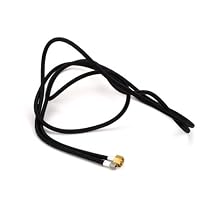
D500 Compressor,30LB PSI

D500 Compressor30LB PSI
Airbrush Compressor

Here is an essential guide that is head and shoulders above the rest! In The Head, expert Andrew Loomis teaches you the basics of drawing the human head, including detailed drawings of a variety of male and female models in different poses. First he covers the basic proportions of the head and the proper placement of facial features. Then he shows you how to render light and shadow, as well as exploring simple techniques for capturing an array of facial expressions and depicting differences in type and character. This comprehensive guide is a welcome addition to any artist’s drawing reference library!
A popular standard in learning to draw heads from memory...
...for beginners & intermediates in ability. It's 32 pages taken from several of his original books- easily my favorite Loomis collection!
In recent decades there have been 3 main teachers in learning to draw heads from memory. For cube-based construction we have George Bridgman. For ball/sphere-based construction we have Andrew Loomis. And for oval/ellipse-based construction, we have the famous teacher of the Dynamic Drawing series- comicbook artist Burne Hogarth. Many of today's Japanese animation & comicbook instructionals are using these very same principles, along with some of the teachings by the Famous Artists School. My current interest is in oval & cube-based construction, but it's Loomis' famous *ball/sphere-based* construction here that many people consider to be the BEST. All artists, from beginners to even professionals(!), could easily benefit in learning these 3 popular standards.
In any case, this is a great work *in pencil* on heads of all kinds. All popular aspects of construction are covered: men, women, children, teens, elderly, fashion-models, proportions, rythmic lines, planes, anatomy, bone structure, simple lines & shapes, perspective, common actions, expressions, clear line drawings, and even full-blown tonal studies (whew!). That's a lot in just 32 pages. It's all done in a classic mid-20th century style, similar to Jack Hamm's excellent Drawing The Head And Figure. My favorite pages here are p.26, p.27, and p.30, because these are his clearest & most detailed pure line drawings- exceedingly great to copy & learn from. A tremendous help for anyone interested in learning to draw from memory- get this great book today!
P.S. ...just so you know: this reviews page is shared by 2 Loomis books. The 1st is his slim & tall, 32-page Walter Foster paperback collection currently entitled Drawing: The Head (HT197). This HT197 guide was also known as Heads/2. My review is for this Walter Foster collection. The 2nd book this reviews page is linked to is Loomis' original hardcover called Drawing the Head and Hands; a full-blown book- more than 32 pages. At this writing, this 2nd book is out of print. The real reason these 2 books share these reviews is that the shorter, Walter Foster collection takes a few pages from several books, including pages from this full-blown Drawing the Head and Hands.
As I understand it, Loomis actually *created* ball/sphere-based construction for heads, printed in Fun With A Pencil circa 1939- and I see no evidence to contradict this. And today it's one of the most popular methods around. His books being out of print confuses many! That's why I give this 5 stars: instead of slamming Walter Foster's publications for their lack of completeness, we should thank them for keeping Loomis' name alive(!). If it weren't for this Drawing: The Head collection, I might never have given his Figure Drawing For All It's Worth a chance. Now I have both- thank goodness!
walter foster publishing ruins what they touch
I held Andrew Loomis's books in the highest esteem. Then walter foster came along and decided to cut cost by publishing every third page and discarding everything in between. Think this statement is absurd! Compare Andrew Loomis's books BEFORE and AFTER walter foster got his hands on them.
bringing the diffucult within reach
The human body is the hardest thing to sketch, and of its parts, the head and hands are most intimidating. Loomis found a way to bring these challenges into the realm of the achievable for amateurs, with a text that, while a bit old fashioned in style, feeds the drawing brain.
As a bonus, Loomis'own pieces, particularly the finished sketches, are deeply satiafying to view. To be sure, the style is genre-past, but the evocation is sweet, recent, and wholly American. One can see in the sketched heads the tender, yearbook faces of our parents now aged or departed.

Great book
This book is great for beginers and good for someone a little further along. It gives you most airbrush tricks that you'l need to paint whatever you want to paint.
If you only buy one airbrush book, this is the one!
I hate to gush but this is, imho, the single best book on airbrushing that I've seen. It covers technique from beginner to advanced. The instructions are straight forward. I suppose they could seem boring if you're an advanced artist. Since I learn from even a rehash of what I already new, I wasn't bored.
Unlike other reviewers, I wasn't disappointed because it doesn't cover painting motorcycles or helmets. The title is fairly straightforward and a good clue to what the book covers. If you're only interested in painting motorcycles, try How to Custom Paint Graphics here on Amazon.
If on the other hand, you see an airbrush as another tool in expressing yourself through art, get this book. Vero is a master at solidifying visualization. He introduced the use of shields and the book contains a template for his design for one of the most versatile shields around.
When you aren't using it for reference, I recommend putting it on the coffee table. People who drop by my apartment are instantly drawn to the cover which features an illustration of Vero's "Study of a Girl". Instant conversation starter!
Rado Vero is recognized as one of the greatest illustrators who ever lived. Reading his thoughts on airbrush and different ways to create are as invaluable as reading Da Vinci's ideas on creating perspective. It didn't bother me that it was first printed in 1983. Nothing in this book has been outmoded. In fact, many of his ideas, such as use of shields, are now the standard in art schools. I expect it to be equally as valid in 2083.
I have bought multiple copies of this book and given them to friends who are just getting into airbrushing. I expect that I will buy quite a few more before it's over.
If you can only get one book on airbrush...
... this is the one.
Covers the mechanical stuff more briefly than many, and has a nice section on fixing problems, including straightening a bent needle. Gets briskly on to the =use= of the thing, and runs a series of exercises to help you get the hang of techniques, including learning how to draw freehand. This guy is not hung up on anal-compulsive frisket cutting, but recommends a "universal mask" you can make out of a styrene or metal sheet that will do for a lot of work.
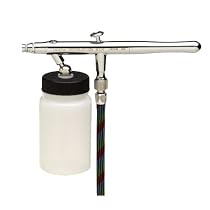
Start off airbrushing with the industry leader - Iwata. Made for users at all levels, this top-of-the-line Revolution Series brush is a great value. With breakthrough technology and performance, this airbrush outperforms all others in its price range. Its features include: an internal mix airbrush; ergonomic handle design; fine detail to 1-1/2" spray pattern; larger nozzle and needle combination (0.5-mm) that makes for easier spraying of thicker or heavier paints; redesigned trigger mechanism and larger needle-chucking nut for easy assembly; and replaceable internal Teflon needle packing for use with solvent-based paints. * A bottle-feed, dual-action airbrush for general-use spraying * Siphon-feed model makes it easy to swap out bottles of specific colors quickly * Useful for T-shirt painting, model-railroad landscapes, R/C car painting, airplane models and other general art, hobby and craft projects